
Opening More Doors... How Audiobooks Support Visually Impaired Readers
Audiobooks create another route into stories, knowledge and imagination. For people who are blind or visually impaired, listening can make written work easier to access in everyday situations, from relaxing at home to travelling across town. For authors, publishers and content creators, producing an audio edition is an opportunity to make more of their work available to more people.
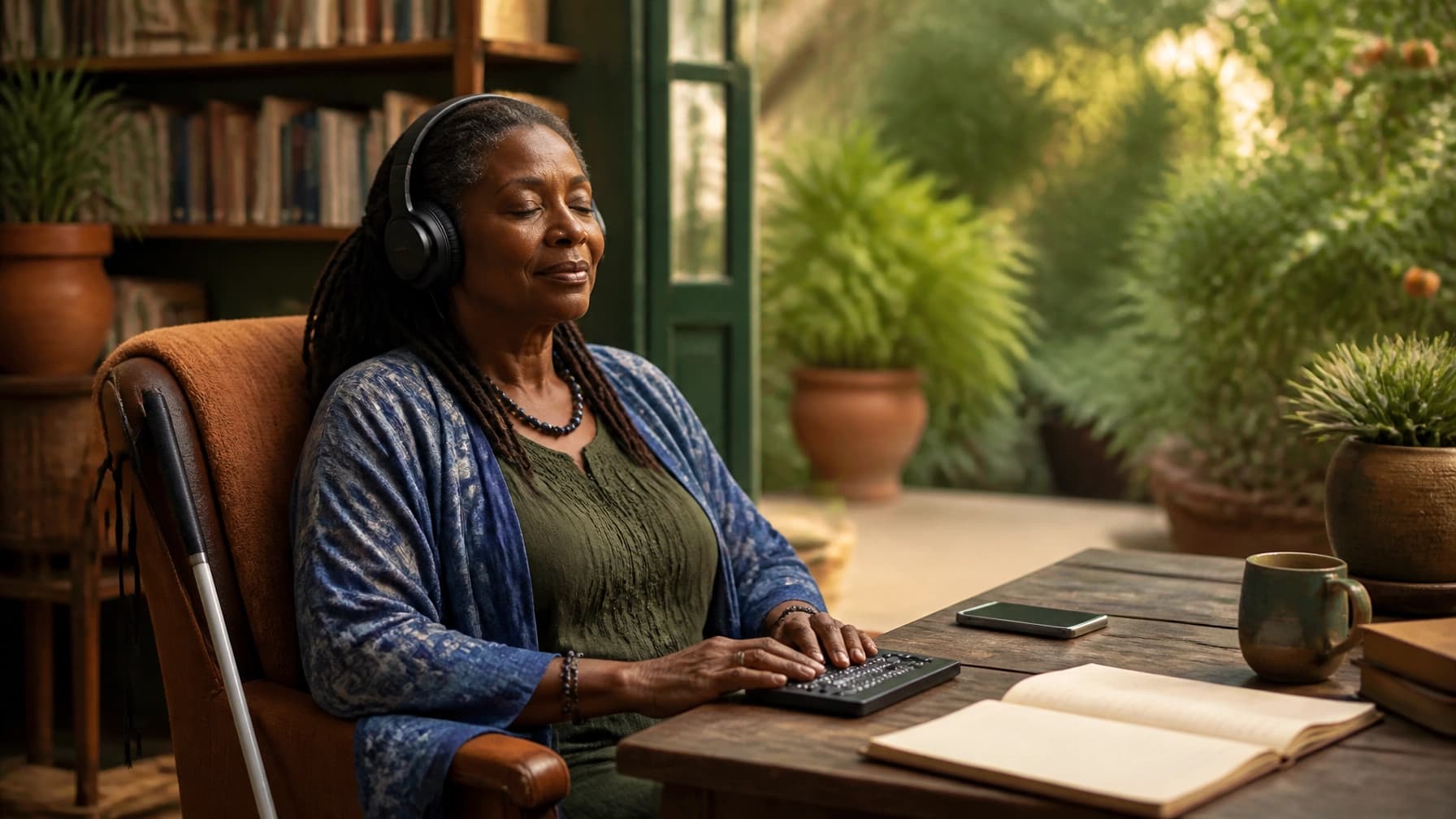
A book should not become inaccessible simply because it was designed for the eye.
With an AI-powered audiobook generator such as Lama Mani, you can turn a manuscript or eBook into professional-quality audio without hiring a studio, coordinating lengthy recording sessions or learning complicated production software.
Audiobooks expand access without replacing other formats
Accessibility is not one-size-fits-all.
People who are blind or visually impaired have different reading habits, technologies and preferences. Some may use braille every day. Others may rely on screen readers, magnification software, accessible eBooks, large print or a combination of tools. Many people move between formats depending on the task, their environment and how they want to engage with the content.
Audiobooks are part of that wider ecosystem.
They should complement, rather than replace, braille, screen readers, accessible eBooks and other assistive technologies. Braille remains important for reading spelling, punctuation and written structure. Screen readers can help people navigate websites, documents and applications. Accessible eBooks can offer both text and audio compatibility, allowing readers to use a refreshable braille display or other preferred technology.
Audio adds another flexible option.
The RNIB Talking Books service demonstrates the enduring value of spoken books in the UK. Its free library offers thousands of fiction and non-fiction titles in formats including digital download, DAISY CD and USB stick, alongside braille and other reading resources.
The message for creators is clear: offering your work in audio can help remove one more barrier between your ideas and potential readers.
Hands-free listening creates more freedom
Reading with your eyes requires visual attention. Listening does not.
An audiobook can be enjoyed while preparing a meal, resting, travelling by public transport or taking a gentle walk. It can offer access when a person’s hands are occupied, when print is tiring to focus on or when a screen is not convenient.
This flexibility can be particularly valuable for people who are blind or visually impaired, but it benefits many listeners too. A parent can listen while managing a busy household. A commuter can continue a novel between destinations. A student can revisit a chapter while away from their desk.
There is no single “right” way to experience a book.
An audio edition gives your audience the freedom to choose the format that suits them at that moment. That choice is a meaningful part of audiobook accessibility.

Good structure makes an audiobook easier to navigate
An audiobook is not simply a written book read aloud from beginning to end. Its structure matters.
Clear chapter divisions help listeners understand where they are and return to a specific section. Descriptive file names, sensible ordering and consistent transitions can make the listening experience more straightforward, particularly when a listener is navigating with a screen reader or an accessible audio player.
When preparing your manuscript, consider:
Using clear and consistent chapter headings.
Keeping chapter files in the correct order.
Removing references such as “see the image below” unless the visual is described.
Explaining charts, diagrams or tables where they are essential to the content.
Avoiding unnecessary front matter that makes the audio edition difficult to enter.
Checking that names, specialist terms and abbreviations are pronounced consistently.
Many dedicated talking-book services use structured formats designed to support navigation by chapter, section or page. Even when you are creating a conventional audiobook, the same principle applies: the listener should be able to move through the book with confidence.
Simple organisation makes a difference.
Playback controls let listeners shape the experience
Different listeners may prefer different playback settings.
Some people enjoy a measured pace, while others prefer faster narration. A listener may want to pause frequently, replay a sentence or move backwards through a paragraph. Adjustable speed, volume and skip controls allow people to tailor the experience to their own needs.
These controls can also help listeners manage attention, fatigue and the complexity of the material. A detailed non-fiction chapter may benefit from a slower pace. A familiar novel may feel comfortable at a faster setting.
As an author, you cannot decide every listener’s ideal playback speed. You can, however, provide audio that remains clear and natural across a reasonable range of settings.
That begins with well-produced audiobook narration.
Clear narration supports comprehension and enjoyment
Professional-quality narration is about more than having a pleasant voice.
The delivery should be clear, consistent and easy to follow. Pauses should feel natural. Sentences should have enough space to breathe. Dialogue should be distinguishable without becoming exaggerated, and the overall volume should remain comfortable.
For fiction, voice selection can help listeners recognise characters and follow changes in dialogue. For non-fiction, a calm and assured voice can make complex ideas feel more approachable.
This is where Digital Narrator technology can support independent creators. Lama Mani offers a selection of voices, including standard and premium options, so you can choose a sound that fits your book. You can also assign different voices to specific characters when your project needs greater distinction between speakers.
The aim is not to add unnecessary performance. It is to make your words resonate naturally through audio.
Before publishing, listen for:
Mispronounced names, places or technical terms.
Abrupt pauses or unnatural sentence breaks.
Inconsistent character voices.
Sections that sound too fast, flat or difficult to follow.
References to visual material that need spoken description.
Chapter openings and endings that are easy to identify.
A careful review helps create a richer and more respectful listening experience.
Turning an eBook into audio can be refreshingly simple
Audiobook production has traditionally involved studios, microphones, narrators, engineers, editing and multiple rounds of approvals. That process can produce excellent results, but it may be difficult for an independent author or small publisher to manage.
The alternative does not need to be complicated.
With Lama Mani’s simple, no-studio-required workflow, you can upload written content, choose a Digital Narrator and begin your eBook to audiobook conversion in a few clear steps.
The platform is designed to reduce friction around the parts of production that often slow creators down:
Simple conversion: Transform written documents and eBooks into narrated audio through an intuitive platform.
Flexible voice selection: Choose from a library of voices suited to different genres, subjects and characters.
Rapid processing: Generate chapters or complete books in minutes, giving you more time to listen, review and refine.
Professional-quality output: Create polished audio with natural-sounding Digital Narrator delivery.
Transparent word-based billing: Plan costs according to the amount of text and the voice quality you select, rather than studio hours or unpredictable retakes.
AI narration does not remove your role as the author. You remain responsible for the manuscript, the structure, the pronunciation choices and the final quality check.
The technology simply handles much of the heavy lifting.

Accessibility starts with thoughtful preparation
Creating an audio edition is an important step, but accessibility also depends on how you present and distribute it.
Make the audiobook easy to find. Include accurate title, author and chapter information. Provide a clear description of the work. If your book contains essential visual information, consider creating a companion document with accessible descriptions or a text-based alternative.
You can also review the accessibility of your own website and sales materials. Make sure links are clearly labelled, headings are logically ordered and important information is not presented only through images.
Most importantly, avoid assumptions.
Do not describe an audiobook as suitable for every visually impaired listener. Instead, explain what it offers: an audio format, clear chapter structure, adjustable playback through compatible players and narration designed for comfortable listening.
Where possible, invite feedback from people who use assistive technologies. Their experience can reveal practical improvements that are easy to miss during production.
Your work can reach further in audio
An audiobook is more than an additional product format.
It can be a way for someone to access your novel independently, revisit your ideas while away from a screen or enjoy your work in a setting where print is not practical. It can help your writing take part in a more inclusive publishing landscape.
For independent authors, the route from manuscript to audio no longer needs to be blocked by cost or complexity. A streamlined audiobook generator lets you create a professional edition without building a recording studio or becoming an audio engineer.
Your words already have something to say.
Now you can give more people the opportunity to hear them. Create your audiobook with Lama Mani and open another door to your story, your knowledge and your creative voice.
